

Articles, Design-Build Landscaping, Outdoor Living Enhancements
The Art of Landscape Lighting: Techniques Kelowna Homeowners Should Know
Jul
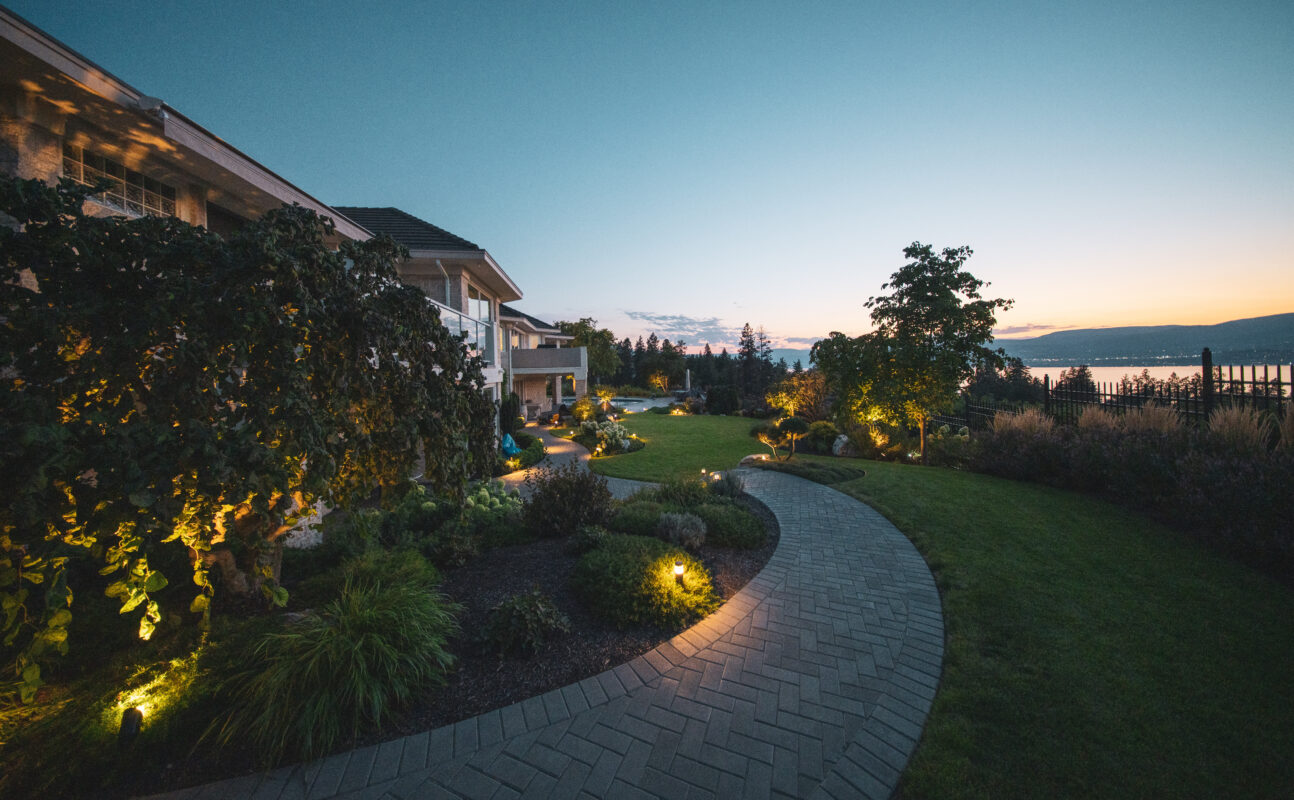
Landscape lighting design is the practice of placing artificial light sources to highlight a property’s architecture, plantings, and hardscaping while guiding movement safely after dark. Done well, it works less like a switch and more like a composition, layering light and shadow the same way a designer layers plants and stone.
Anyone can point a fixture at a tree. Getting a property to look the way it does in the photos you save on Pinterest takes an understanding of landscape lighting techniques: which fixture goes where, how bright, and at what angle. We work with premium fixture brands like Kichler to bring these techniques to life. Below, we break down the core techniques we use at Creative Roots, and how they come together on an Okanagan property.
Core Landscape Lighting Techniques
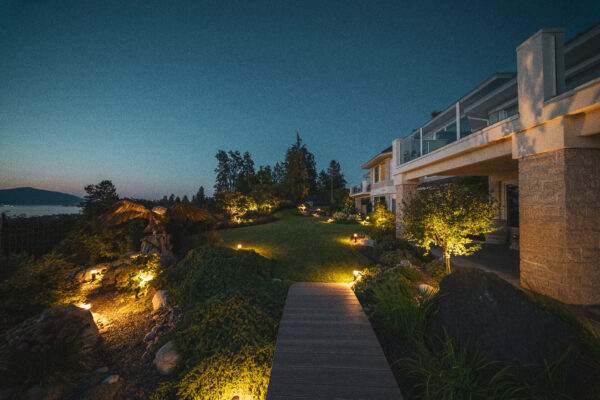
Every lighting plan draws from a handful of proven techniques. Most properties end up using several at once, chosen to match the feature in front of them.
Wall-Wash Lighting: A soft, even wash of light spread across a wide section of wall or facade. Wall-washing avoids harsh hot spots and works well on stucco or siding where you want gentle illumination rather than a dramatic accent.
Grazing: Light mounted close to a textured surface, aimed up or down at a steep angle. Grazing catches the ridges and shadows in stone, brick, or timber, making textured hardscaping look far more dimensional at night than it does under a flat porch light.
Silhouette Lighting: A fixture placed behind an object and aimed at a flat surface, like a wall or fence, so the object’s shape stands out as a dark outline. This works particularly well on ornamental grasses, sculptural trees, or anything with an interesting profile.
Shadowing: The inverse of silhouetting: a light is placed in front of an object and aimed at a wall behind it, casting the object’s shadow onto the surface. Shadowing adds movement and depth to plant beds, especially with trees that have interesting branch structure.
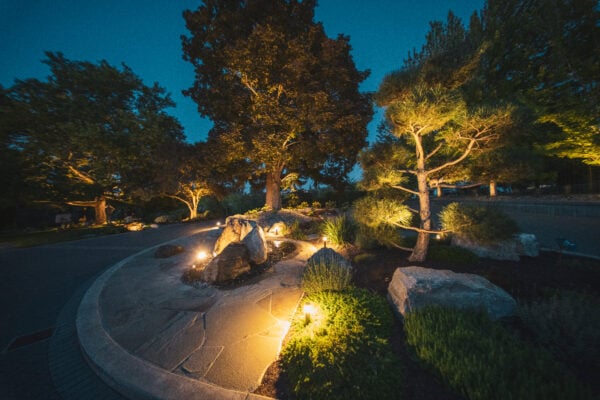
Moonlighting: A fixture mounted high in a mature tree and aimed downward, filtering light through the branches to mimic natural moonlight on the ground below. It’s one of the more subtle techniques, but also one of the most requested once people see it in person.
Underwater and Mirror Lighting: For pools, ponds, and water features, underwater fixtures highlight movement and depth, while mirror lighting places fixtures around a still body of water so the surrounding landscape reflects across it. Both techniques turn water into a focal point after dark rather than a dark gap in the yard.
Path and Spread Lighting: Lower-profile fixtures set along walkways or tucked into garden beds to spread light across the ground. This is the most functional of the techniques, but it still carries the design load of guiding the eye and the feet along a route.
Hardscape Lighting: Integrated lighting for steps, retaining walls, outdoor kitchens, and seating areas. Often built into the structure itself during construction, hardscape lighting blends fixture and feature so the light source disappears and only the effect remains.
Layering: How These Techniques Work Together
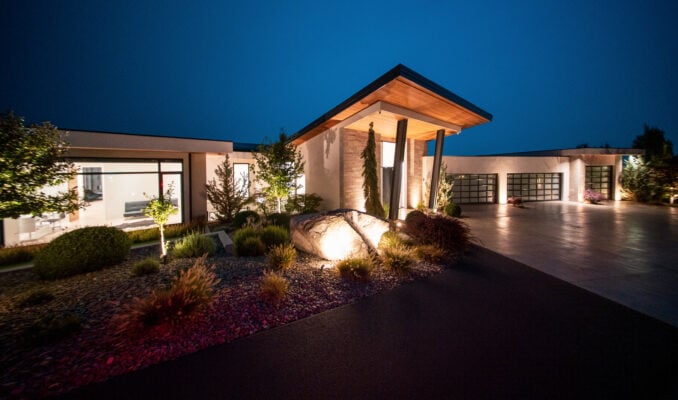
A lighting plan rarely leans on just one technique. The best results come from layering: a foreground of path and step lighting for function, a mid-ground of accent and grazing lighting on features and textures, and a background of moonlighting or silhouetting for depth. Layered this way, a yard reads with the same sense of dimension at night that it has during the day.
Colour temperature matters here too. Warmer light, in the 2700K to 3000K range, reads as inviting and natural, closer to firelight than to a parking lot. We default to warm tones across most residential work, reserving cooler, brighter light for areas that need it functionally, like driveways or entry points.
Function Meets Form
Good lighting design earns its place by doing double duty:
Safety: Steps, grade changes, and transitions between surfaces are the first places we light on any property, before aesthetics enter the conversation.
Security: A well-lit exterior removes the hiding spots that make a property an easy target, and it signals that the home is cared for and occupied.
Extended outdoor living: In the Okanagan, patios, pools, and outdoor kitchens get used well past sunset for most of the year. Lighting is what makes those spaces usable once the sun goes down.
Curb appeal: A property that’s thoughtfully lit reads as intentional and well maintained, day or night.
Designing for an Okanagan Property
Kelowna, West Kelowna, and Lake Country properties bring their own opportunities: lake-view lots where mirror lighting on a pool or water feature plays off the view, mature trees suited to moonlighting, and stone retaining walls built for grazing. Winter is also worth planning around. With daylight hours shortest from November through February, a property’s lighting design carries more of the visual weight for a larger share of the year here than it does in many other climates.
Frequently Asked Questions
What is the difference between landscape lighting and outdoor lighting? Outdoor lighting is the general category covering any light fixture used outside a home. Landscape lighting specifically refers to the design and placement of that lighting to highlight a property’s plantings, hardscaping, and architecture, rather than just providing general illumination.
What type of landscape lighting is best for pathways? Path and spread lighting is the standard choice for walkways, using lower-profile fixtures placed along the route to light the ground without creating glare at eye level.
How many lighting zones does a typical property need? It depends on the size and layout of the property, but most residential plans separate a yard into zones such as entry, pathways, patio or outdoor living areas, and feature plantings or trees, each lit and controlled somewhat independently.
Is landscape lighting worth the investment? For most homeowners, yes. Beyond the safety and security benefits, lighting extends how much of the year a property’s outdoor spaces get used and adds noticeable curb appeal, particularly on properties with strong architecture or mature landscaping to show off.
Does Creative Roots design lighting as part of a larger project, or on its own? Both. Lighting is often planned alongside a full design-build project so fixtures and wiring are integrated during construction, but we also design and install lighting systems for established landscapes on their own.
Ready to see what your property looks like after dark? Get in touch with our team to talk through which landscape lighting techniques suit your property, or explore how lighting fits into a full design-build project. You can also browse our featured projects to see these techniques in place.
Making neighbours jealous since 1994.